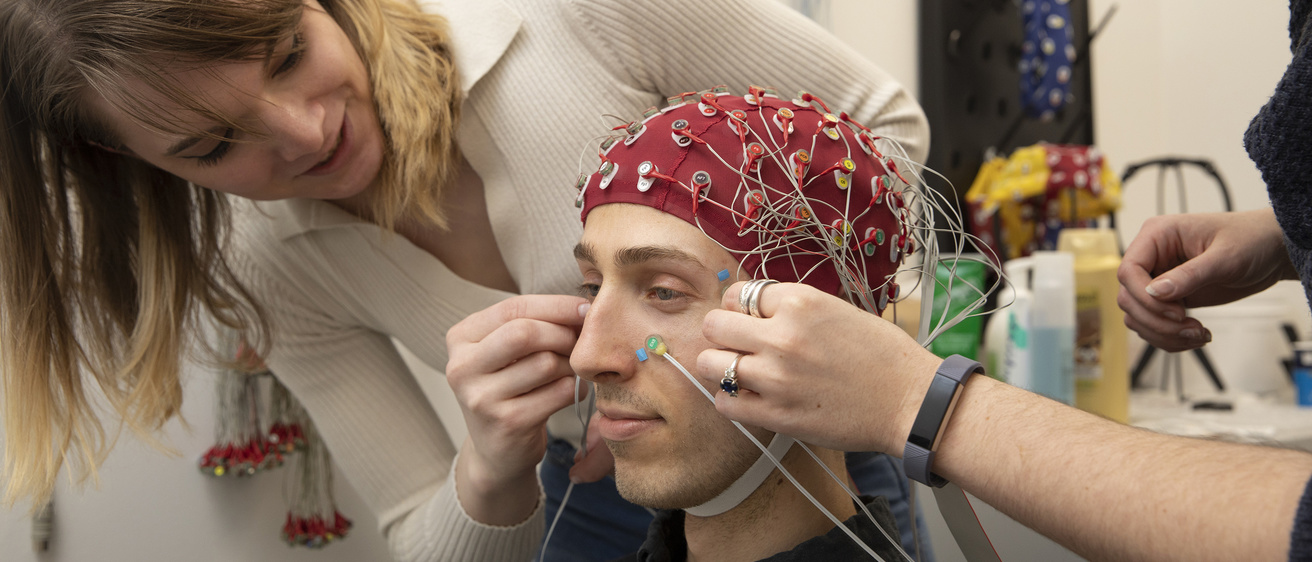
Hands-on research experience from the start
Our doctoral program is a research-focused, STEM-designated program that prepares students for careers in research, teaching, and related scholarly endeavors in academic, industrial, governmental, or medical settings. We employ an apprenticeship-based model in which students are accepted into a faculty mentor’s laboratory. Accordingly, prospective students are encouraged to reach out directly to potential faculty mentors before applying.
Our faculty are recognized nationally and internationally for their research contributions, and are committed to providing exceptional training to the next generation of psychological scientists. In addition to running their own laboratories, our faculty collaborate extensively with colleagues in the Iowa Neuroscience Institute, the DeLTA Center, and other entities within and beyond the university. In addition, many of our graduate students participate in the interdisciplinary Behavioral-Biomedical Interface Training Program.
When students apply to the program, they choose from one of three training areas (behavioral and cognitive neuroscience, clinical science, or cognition) or the individualized training track. Our training areas aim to provide a flexible and interdisciplinary framework for graduate training. We aim to break down barriers within our field, not maintain them: For that reason, we have only three formal training areas, and most of our faculty are affiliated with more than one.
Our research groups are informal collections of faculty based on common areas of research. Prospective students should review these groups and the list of research topics to get a feel for the breadth and depth of research interests in the department.
Financial support
Typically, students in our doctoral program receive 12 months of financial support for at least five years. This support is contingent on available funding and adequate progress in the program.
Two options for neuroscience students
Students interested in neuroscience can apply through our behavioral and cognitive neuroscience (BCN) training area. Also, many faculty in our department train students who are in the interdisciplinary graduate program in neuroscience; students in that program, unlike those in BCN, typically rotate in several labs before choosing one. Students should discuss the relative benefits of the two programs with potential mentors before applying.